Showing posts with label mum. Show all posts

Friday, August 26, 2016

How to get your baby to sleep - innovative ideas

As a new mum it's highly likely that you heard about sleep deprivation but never really understood it until now. It would be great if all babies just fell asleep when they were tired but the reality is that all babies are different and most babies need some form of assistance from you as the new mum to help get to sleep and to stay asleep (download my free parenting ebook that details how to parent with child temperament in mind here). 

When it comes to your baby sleeping there are two very important motivations - 1) to give your baby a rest and 2) to give you a rest. The second point is vital for both your sanity and for your ability to parent in a calm, rational and safe manner. So bearing this in mind there a few things you need to decide on:

A) am I prepared to let my child cry it out?

B) will my baby even respond to crying it out (see the child temperament ebook to understand that some babies won't)

C) Do I care if my child does not sleep in a cot - eg co-sleeps safely?

D) what does my child need to go to sleep - eg comfort, reassurance, food?

E) am I prepared to relax my expectations and do what I think is right for us, rather than worrying about what I think will make others happy?

Now, besides all the usual things by now you know to look out for in your baby (eg first signs he/she is tired - like pulling ears and hair or yawning) there are a few extra things you can do to help your baby sleep - once you have addressed A - E above.

1) If your baby has a sore tummy due to excess wind, try picking her up and with one hand gently on the lower tummy gently bounce her/him to allow the wind to move down and pass through. You can also try rubbing the tummy or gently holiding both feet and rocking the legs up and down and side to side to pass the wind. Both my girls had lots of wind and these methods worked for them. We also used a natural product called Colic calm which we found very beneficial.

2) if your baby is regularly waking up he/ she may just need extra comfort. Here you have several options. 

-) invest in a baby sling so your baby can sleep with you and you can still get on with your day. Personally I have used the Baba Sling for both of my kids and I love it because it's adaptable up to 2 years of age and has freed me up to have a normal life whilst my girls have received the comfort they need.
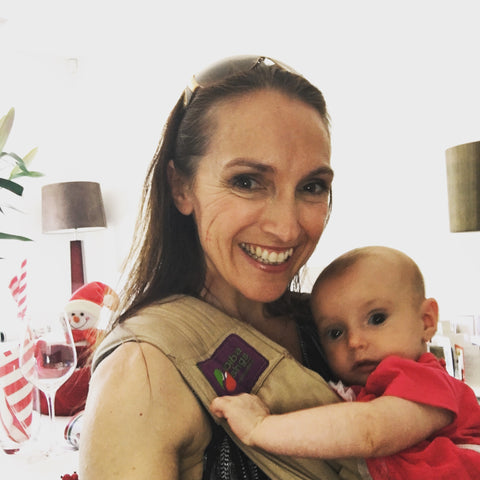
 Baby wearing Baba sling

 -) if your baby keeps waking up, check if your baby has a wet or dirty nappy. Some babies really feel uncomfortable so need to be changed more often. Keep the nappies close to the cot and sleep baby in a grow bag so it's quick and not too disruptive to change the nappy at night.

-) ensure your baby has had enough to eat so she's only waking up when expected. When your baby gets older make sure you leave at least an Hour between the last meal and bedtime to avoid a sore tummy, when you're baby is smaller though keep her in a more inclined position in bed, the pram etc to avoid excess wind. For instance place an extra folded blanket under the head of the mattress to incline the top only slightly so your baby won't roll to the bottom of the bed. Remember to always follow SIDS sleeping guidelines so your baby is save and don't place any blankets on top of your baby which could cover his head.

-) with a baby who needs extra comfort it's all about either giving in to co-sleeping (again ensuring you're following SIDS safe sleeping guidelines) or investing in a cot that you can place next to your bed so you can gently roll your baby over to the open cot next to you without you baby realising. I highly recommend the Bednest Bedside Cot. Not only is it beautiful, it serves this purpose perfectly.

There are lots of things you can do to ensure you get some sleep and your baby does too. The important thing is to not get stressed if your baby doesn't just gently drift off to sleep. Your baby has spent months close to you, so it only makes sense that he/she may need some assistance to get to sleep. Be kind to yourself and be patient. You may need to try a few different things before you get it right. 

If you're a new mum and you feel you need some more personalised support, contact me at info@happylife.net.au to book in a private session or visit https://www.selfesteemonline.com.au/products/coaching_for_new_mums for more information about Coaching for New Mums

Lizzie O'Halloran, BBSc, MASR, NLP Prac

Thursday, October 9, 2014

Five ways to reduce stress at work

It's easy to say "just relax", but when you're feeling overwhelmed and don't know where to run first, you need a few quick fixes to get you back on track as quickly as possible. Below are a number of quick and easy ways to reduce stress whilst you're at work:

1) Write things down

Often the feeling of being overwhelmed comes from having too much in your mind and hence relying on your memory to get you through. The worst part of neglecting to write thins down is that your mind continuously reviews your list if tasks and in turn increases your anxiety over "all the things you still have to do". 

Take 5 minute to write down everything that's racing through your mind. It doesn't matter how small. The idea is to get these thoughts out of your mind and on to a notepad where you can refer to them later.

2) Take a break

You might think you don't have time to take a break, but the reality is if you take a short break (even 15 mins) and go for a walk, you will come back more refreshed, thinking much more clearly and feel like you can cope much better with the demands of your day. I would suggest taking some music to listen to and walking alone. If you want to walk with a friend make sure you avoid talking about work or stressful things in general, otherwise you're not having a proper mental break.

3) Eat slowly

When you're in a rush it's tempting to eat quickly to save time. However eating quickly can increase your heartbeat and cause digestive issues which will of course end up making you feel sick and even more stressed.

All you need is 5 minutes to just chew slowly and mindfully. In a way this becomes a little mental break. Once again avoid reading work related material whilst eating and avoid working with one hand and eating with the other.

4) Breathe 

The most obvious thing that happens when you're stressed is your heartrate increases and you begin to breathe very rapidly. Make sure you are conscious if your breath and slow down. You will work much more efficiently in this state, than if you allow your heartrate to race too rapidly.

5) Listen to some relaxing music 

Whilst you're engaged in something not too mentally taxing (like checking emails), listen to some relaxing music such as Bebel Gilberto's music. Take the music in and calm yourself down. 

Feeling calm in the workplace is essential for high performance, so don't dismiss it. Feeling calm you will feel much more in control. A simple 5 minute activity can settle you down and help you to think much more clearly - something that is often negatively impacted when stressed.

For more support or inspiration visit Happy Life at: www.happylife.net.au
Follow us on Twitter: @lohalloran72
Follow us on Instagram: LOHALLORAN1

Thursday, August 1, 2013

How to slow down to beat stress and illness

When you push yourself too hard physically and emotionally you can find that you take a lot longer to recover from colds and flu. Modern life does not tend to present you with many opportunities to take time out to fully recover from mild illness. Thus, once your obvious symptoms dissipate, you tend to either feel too guilty to continue to rest and recuperate, or you have too much on your plate to do so.

There are a finite number of hours in the day and your list of 'to-do's' can often feel overwhelming, leaving you little time to allow yourself permission to rest. This is particularly true for high level professionals and parents, who are relied upon significantly by others - day in and day out. In addition to external pressures, it's very common to feel guilty about resting, when there is still so much more to be undertaken and achieved.

So, how do you fully recover from illness in order to function at your optimum - most of the time?

In order to recuperate fully and feel your best, there are the 'usual' things to do, such a sleep well/enough and eat well. However, in reality recent research shows that in order to achieve our ever growing list of tasks, we find it easiest to skimp on sleep. Shaving a few hours here and there can add a significant number hours to your year, so it's no wonder it's so tempting to give it up and thus to maintain the recommended 8 hours of good quality sleep a night.

Instead of trying to change your sleeping habits, a quick and easy way to improve your health (before, during and after illness) is through slowing down. Most people tend to make the misguided assumption that in order to achieve, one must move with speed. The problem with this theory is the body's reaction to being placed under pressure on a regular basis - STRESS. Regular, ongoing stress has been shown to cause a short-term reduction in IQ. This is why, it can be very difficult to think clearly and make rational decisions with your stressed - and thus increase the chance of making mistakes and having to end up working harder. Rushing around tying to achieve a million things in a day/week/month/year usually ends up resulting in a lot of wasted time and energy.

In contrast, if you were to start your day with a few deep breaths, 5 minute relaxation exercises and made a conscious effort to slow down, you would be able to think more clearly and rationally and thus be much more productive during the day.

For instance, most people arrive at work and feel anxious as soon as they begin to look at emails, to-do lists and speak to other stressed co-workers. They tend to spend the day frantically trying to spot mutiple fires, feeling overwhelmed, stressed and unproductive. If instead of this strategy, they walked into the office, took out a notepad and began to scan through emails, to-do lists and verbal requests from staff first thing in the morning and then developed a daily priority list, they would be able to tick off the most important jobs they had achieved that day. This would in turn provide both a feeling of achievement and a sense of control.

Undertaking such a morning task would take between 15-30 minutes per day, but would give back many more hours of productive work in return. The act of slowing down and gaining control is vital for health and wellbeing, particularly in this busy world we live in.

Your mind significantly impacts your physical health and emotional state, so if you're feeling run down or overwhelmed, try to simply slow down. Try it for 1 week and see how much it improves your life.